
Track every demo you send, from sent to signed
You finish a track, send it to nine labels across three weeks, and the only record of where it went is scattered across your sent mail, your browser history and your memory. Two months later you cannot answer the simplest question about your own career: who did I send my track to, and did any of them ever reply? Sessions keeps that record attached to the track itself.
This is the part of releasing music no DAW touches. Ableton knows your arrangement; it has no idea you emailed this bounce to a label on the 3rd and heard nothing back.
Why demos vanish from your own records
Nobody sets out to lose track. It happens because sending is never one thing. A private link here, a LabelRadar upload there, a contact form that gives you no receipt at all, an email typed on your phone at 1am. None of those leave a consistent trail, and a few weeks of it produces questions you cannot answer: which version went out, was it this label or their sub-label, and is it fair to follow up or did I already nudge them twice?
Silence makes it worse. A rejection at least closes the loop, even though it usually arrives with no feedback attached. The far more common outcome is nothing at all, forever, and silence looks identical whether they passed, never opened it, or you sent it to a dead address. Without dates you cannot even tell how long you have been waiting.
The demo submission spreadsheet, and why it slips
Almost every producer who has been at this a while ends up building the same thing: a demo submission spreadsheet. Label, contact, date sent, track, a status column with color coding, a notes column for what they said. It genuinely works, right up to the week you stop updating it.
The failure is structural rather than lazy. The spreadsheet is a second place. Sending happens in your browser or your mail client; logging happens in a different app you have to remember to open afterwards. Every send is a chance for those two to drift apart, and once the sheet is a week behind you stop trusting it, and once you stop trusting it you stop filling it in. It also knows the title of your track and nothing else about it: it cannot play the bounce, does not know the BPM or key, and has no idea which project file it came from.
Start with the label book, and it is free
Before tracking anything you need somewhere to keep the labels themselves. The label book is a searchable library where each label carries the things you actually need at the moment you decide to send:
- The submission route: a demo email, a website form, a LabelRadar page or something else entirely. This is the field that saves the most time, because hunting for the current demo address is half the friction of sending.
- Genres, on a normalized set of tags, so you can pull up the labels that plausibly fit the track in front of you instead of scrolling the whole book.
- Affiliations with reference artists, shown as chips. If you keep a list of artists whose lane you are in, you can work backwards from them to the labels that release them.
- Research notes on whether they are open to demos, written as prose.
Be careful with that last one, because it is not more than it claims to be. The open-to-demos field is a research verdict in words, not a guaranteed flag. Labels close their inbox, change policy, or say "closed" on the site while an A&R still listens to everything that lands. Read it as guidance for where to spend effort, never as a promise. The book starts empty and becomes yours as you research: add a label once, with its route, genres and your own notes, and it is there for every future track.
The whole label book is free. No cap, no trial clock.
Sending and logging as one action Pro
Here is the piece that fixes the spreadsheet problem. When you send a track to a label, you pick the label and hit send once. Sessions opens that label's actual route, the submit link or a pre-addressed email, and records the send in the same click. You write the pitch and send it yourself, as always, in your own mail client or on the label's own form. The log is not a separate chore you might skip; it is a side effect of the thing you were already doing, which is the whole reason it cannot drift out of sync the way a sheet does.
A history that lives on the track Pro
Every track then carries its own per-label submission history, with five statuses that cover what really happens: sent, no reply, rejected, accepted, released. One track, one list, in order, with dates.
Two details do the heavy lifting. First, a send with no reply after 30 days turns amber, and the track shows a banner saying so, which turns "I feel like I am waiting on some people" into a specific list of who to chase this afternoon. Second, when you mark a reply, the wait is worked out for you and shown as replied in N days, so over a year you build a real sense of which labels answer in a week and which answer never.
To be plain about the mechanics: Sessions does not read your email. Reply status is something you record when the reply lands, and the timings are computed from what you log. There is no inbox scanning, and there is nothing watching your mail in the background.
Why this beats the sheet
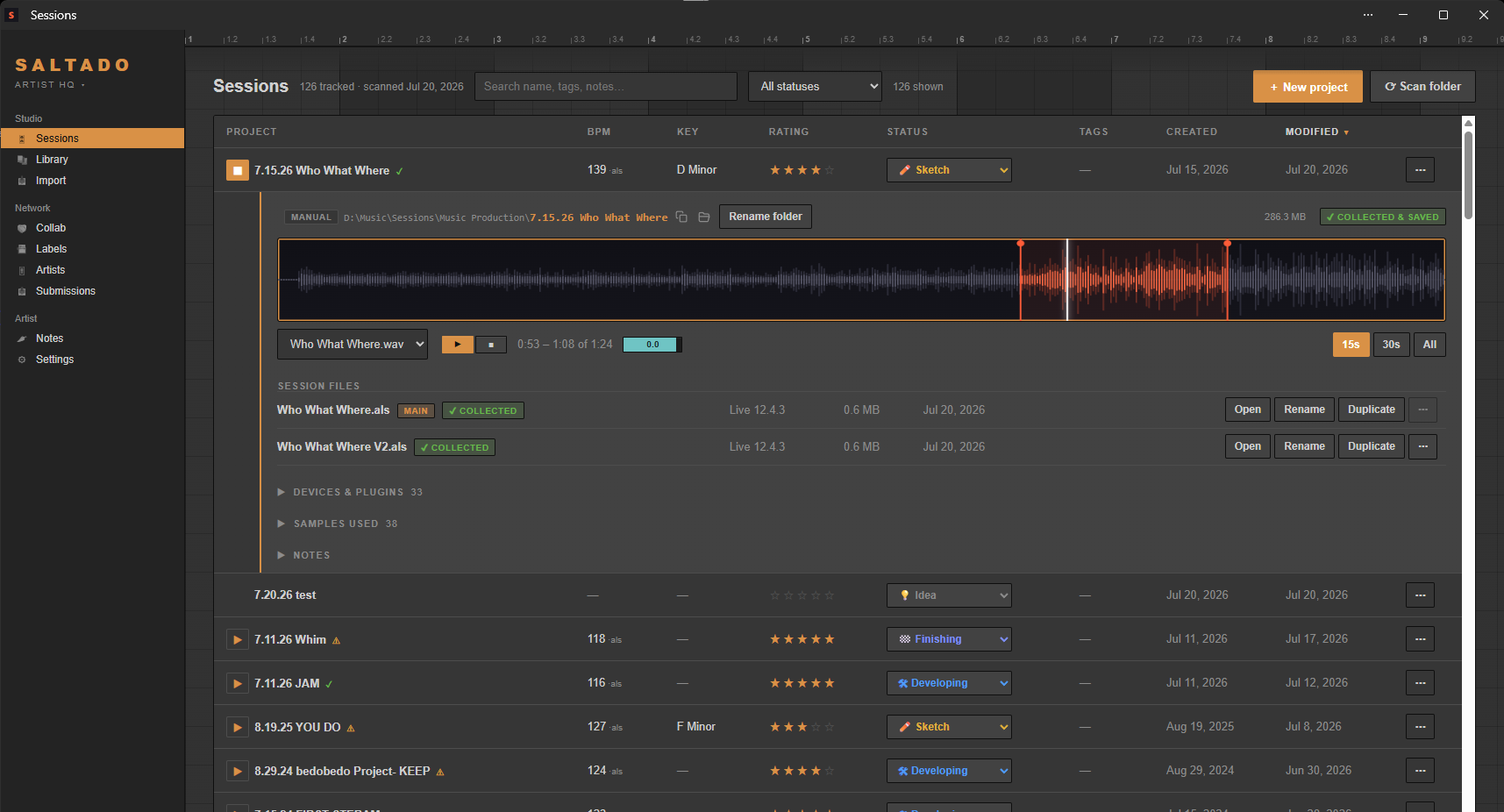
The submission history is attached to the actual track in your library, not to a row of text about it. That means the moment a label finally replies asking for a different mix, you are one click from the bounce you sent, the BPM and key, the project file it came from, and the list of everyone else who has it. You can play the bounce without opening your DAW to check you are talking about the version you think you are.
And if the track you want to send is one of the old ones you half remember, the same library that tracks submissions is the one that finds every project on your drives. Shortlisting from your back catalogue stops depending on what you can recall.
How the workflow actually runs
Step 1
Finish the track and mark it release ready in your library. The submission side
works from the tracks you have flagged as sendable, so unfinished sketches stay out of the way.
Step 2
Shortlist labels from the book: filter by genre, lean on the artist affiliations, read the research
note, and rank the ones whose route you actually have.
Step 3
Send. One click opens the route and logs it. Repeat down the shortlist.
Step 4
Record replies as they arrive: rejected, accepted, or eventually released.
Step 5
Come back in a month and work the amber rows. Follow up, or write them off and move on to the next
batch with a clean conscience.
What this is not
Worth being blunt, because this corner of the industry is full of overpromising. Sessions does not submit anything on your behalf, does not guarantee that anybody replies, and is not a submission portal like LabelRadar or SubmitHub. It has no relationship with any label and no channel to them. It opens the label's own route and keeps your records straight, so your pitch travels exactly as it would if you had done it by hand, because you did. Nothing here promises you a signing. What it promises is that you will always know what you sent, to whom, on what day, and what came back.
Tracking demos is DAW-agnostic: a submission is a track, a label and a date, so it makes no difference whether the project behind it is Ableton, FL Studio, Logic, REAPER or Studio One. And it is all local-first: no account, no cloud, nothing about your music leaving it. Your contacts and your send history sit on your own machine, which is where a list of who rejected you belongs.
What is free and what is Pro
- Free: the entire label book, searchable, with routes, genres, artist affiliations and research notes, plus the full project library for unlimited projects.
- Pro ($44, one time): submission tracking, meaning send-and-log in one action, per-track and per-label history with statuses, the 30-day stale flag and automatic reply timings. A one-time purchase, yours forever, never a subscription.
There is a fuller breakdown on the features page, and the download and pricing live on the homepage. Start with the free label book: even without tracking, having every demo route in one searchable place is most of the friction gone.