
Hear any project without opening your DAW
Listening to an old project without opening your DAW means playing its bounce rather than the project, because a project file holds no audio of its own. Saltado Sessions matches the exports you already have to the projects they came from, by name, then puts a waveform and a play button on the row itself, so you can audition a decade of work the way you would flick through a record crate. It never opens your DAW to do it, and it cannot play a project that was never bounced.
The bounce folder you keep is a workaround
Almost every producer has one: a folder of MP3s or WAVs kept purely so there is some way to listen to old work without launching a project. You maintain it by hand, it goes stale the moment you re-render something, and the naming drifts until you cannot tell which bounce belongs to which project.
The reason that folder exists is the real problem. Opening a project is expensive. A big set can take minutes to load, it may prompt about missing samples, it hogs your CPU, and it pulls you into editing mode when all you wanted was to remember whether the idea was any good. So a drive with three hundred unfinished ideas on it becomes impossible to judge: not because the music is bad, but because auditioning it is too slow to be worth doing. Ideas do not get abandoned on purpose. They get abandoned because nobody ever listens back.
Step 1
Your bounces get matched to their projects for you
Point Sessions at your exports folder once. On every scan it compares the names of the audio files it finds there against your project names, normalized (dates, version suffixes, dashes, underscores and case are all leveled out) and scored for the best fit. Each project quietly gets its audio attached. You file nothing, tag nothing, and drag nothing. If your projects and your exports already share a rough naming convention, which they usually do because you named the bounce after the song, the matching is mostly invisible.
It does not only read the exports folder. Sessions also looks inside each project's own
folder, up to three levels down, because plenty of producers keep the render next to the
set rather than in one central place. A subfolder whose name says what is in it (Bounces, Exports,
Renders, Masters, Mixdowns, Prints) is trusted the same as the project root, and if your habit is a
word we did not guess, you can add your own folder names in Settings and they win over every
built-in list. Folders that hold parts rather than finished audio, Stems, Takes, Vocals, Refs,
Loops, are skipped, so a folder of twenty stems never becomes what the row plays. Loose audio found
somewhere unvouched-for is still offered in the dropdown, just never assigned
automatically, and every candidate shows the subfolder it came from so you are never guessing which
of three files named master.wav you are about to pick.
When the guess is wrong, or when the good render lives somewhere else entirely, pick the file yourself. A manual audio choice survives every rescan, so you correct a mismatch once and it stays corrected, and a bounce you went and found by hand is remembered and kept in the list rather than disappearing the next time something else is selected.
Step 2
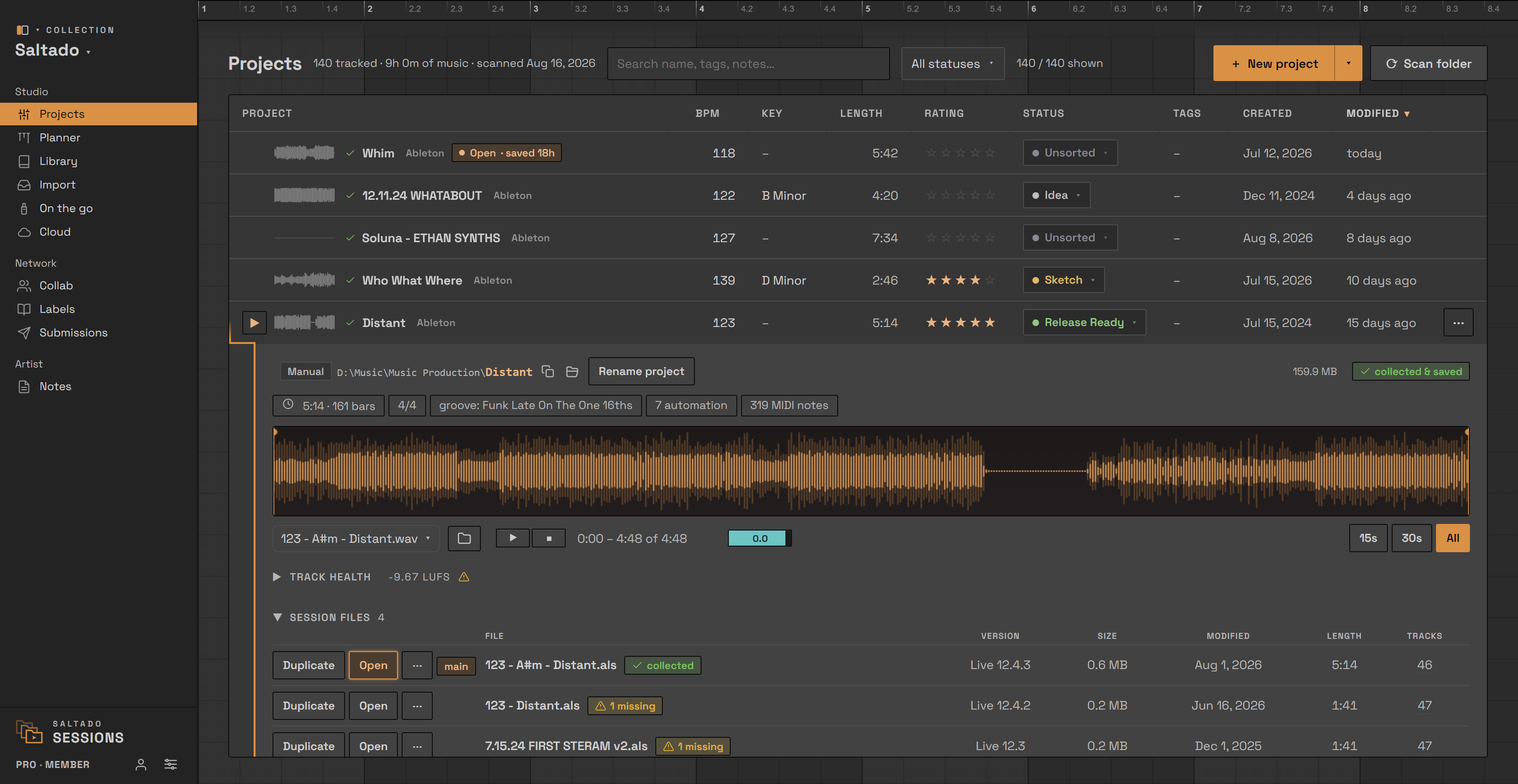
A waveform and a preview window on the row Pro
Expand a project and you get the track drawn as a waveform, with a preview window you can drag anywhere along it. Play and stop, plus window lengths of 15s, 30s or All, where All means the whole file. Fifteen seconds is the triage setting: it is long enough to know what a track is and short enough that you can get through fifty of them. Changing the length while something is playing retargets the window without cutting the audio off.
There is a per-track volume box that works in decibels like the one in your DAW, from silence up to +6 dB, and it remembers each track's setting. Playback is also level-matched, on by default, and it matches by loudness rather than by peaks: each bounce is played toward about -14 LUFS, the same figure the streaming platforms settle on, with any boost capped so matching can never push a track past -1 dBTP. A file Sessions has not measured yet falls back to peak matching until it has. So a quiet rough bounce from 2022 and a finished master sit at comparable volume and you are not reaching for the knob between every track. It only changes what you hear: the loudness figures Sessions reports are measured on the file itself, so they read the same whether matching is on or off.
While a bounce plays, the right edge of that waveform becomes a metering console: momentary and short-term loudness, a running integrated figure with its distance from -14, true peak with per-channel clip lamps, phase correlation and a goniometer. It is there in a simple glanceable form by default and a full console if you want one, so a triage pass can double as a mix check without leaving the row. Pro
Step 3
The preview starts where you left the loop brace
Here is the detail that makes catalog listening work rather than merely exist. If you have never set a preview window on a project, Sessions does not start at bar 1. It reads the arrangement loop brace out of your Ableton set and starts there instead, because the brace is where you were actually working: the drop, the chorus, the eight bars you had on repeat for an hour. Bar 1 of an unfinished track is usually a lonely kick and a riser. The loop brace is the part that tells you whether the idea is worth reopening.
It is computed live rather than written into the database, so if you move the brace in Ableton the default preview follows it. And the moment you drag a window yourself, your choice wins and stays won.
The crate, literally
The list is one of two shapes. Switch the library to grid view and every project
becomes a card with a square sleeve, which is as close to flicking through a crate as a hard drive
gets. Drop a cover.jpg beside the set and Sessions picks it up on its own; if you would
rather choose, the artwork is set from the card's own menu, and a hand-picked cover is never
overwritten by a later scan. Until a project has artwork, the card draws that project's
own waveform in your accent colour, so the grid is legible from the first minute
rather than a wall of empty squares, and BPM, key and length sit along the foot of each sleeve.
Clicking a card opens the same full panel the list rows open. Both shapes are free, and so is
choosing which columns the list shows.
What this changes about how you work
Once listening is cheap, a few things become possible that were not before:
- Triage a whole catalog in one sitting. Go down the list, fifteen seconds each, and rate or set a status as you go. A few hundred projects is an afternoon, not a month.
- Find the unfinished idea worth finishing. Sort by untouched-longest, listen through, and open the two that made you sit up. That is a far better way to pick your next project than opening whatever you happen to remember.
- Shortlist for a label submission. Play the candidates back to back at matched level, decide which three are genuinely ready, then log the sends against the labels you have in the app.
- Check a rough mix away from the desk. The bounce plays from the app, no project loading, no plugins needed.
The same player handles the individual samples a project uses, so when one references a loop you no longer recognize, you can hear it in place rather than hunting through folders for it. That is also part of Pro.
Being straight about what it plays
Sessions plays your exported audio files. It is not a DAW and it has no audio
engine of its own: it cannot render a project, it cannot play your plugins, and it cannot preview a
project that has never been bounced. If a project has no export anywhere on disk, there is nothing
to hear until you make one. That limitation is worth knowing up front, and it is also why bounce
previews work identically across all ten supported DAWs, Ableton Live, FL Studio,
Logic, REAPER, Studio One, Bitwig Studio, Cubase, Pro Tools, Reason and GarageBand, since playing
a WAV does not care what made it. The loop-brace
default is the one Ableton-specific piece, because it comes from reading inside the .als.
Everything happens on your machine. There is no account and no cloud upload, and the scan that finds your projects and bounces is read-only.
What is free and what is Pro
- Free: the scan, the full library view for unlimited projects, list and grid view, cover artwork, BPM and key, length, search, sort, ratings and statuses. Finding your work costs nothing.
- Pro ($44, one time): bounce and sample playback, the waveform and preview window, the metering console, and the rest of the studio library tools. One payment, yours forever, never a subscription.
If your library is not scanned yet, start with finding every old project on your drives, or clean up the pile first. The features overview covers the rest, and pricing is here.